Take It to the Net Review Questions and Answers
API testing has been considered the future of software testing thanks to its advantages in the ability to test for core functionality, time effectiveness, linguistic communication independence, and GUI integration. It becomes a must for software testing projects to ensure product quality. In recent years, many testers will definitely demand to face interview questions when applying for a QA job. The web API testing interview questions below take been nerveless from the exam professionals to help you lot become set up for a new office. More than only an API interview, this list of content will also do good both freshers and senior testers who would like to achieve both general and advanced knowledge in web API testing. An API (Application Programming Interface) is a software intermediary that enables two applications to communicate with each other. It comprises a number of subroutine definitions, logs, and tools for creating application software. In an API testing interview, you lot could be asked to give some API examples, here are the well-known ones: Google Maps API, Amazon Advertising API, Twitter API, YouTube API, etc. Many APIs accept a certain limit set up past the provider. Thus, try to guess your usage and understand how that volition bear on the overall cost of the offering. Whether this will be a problem depends in big function on how information is leveraged. Getting defenseless past a quota and effectively cut-off because of budget limitations will render the service (and whatsoever system or process depending on it) virtually useless. This is one of the primal Web API interview questions. Bellows are four common Web API architectural styles: Web API can be consumed by any clients which support HTTP verbs such as Become, PUT, DELETE, Post. Since Web API services practice not require configuration, they tin can be easily used by any client. In fact, even portable devices such as mobile devices can easily apply Web API, which is undoubtedly the biggest advantage of this technology. API testing is a kind of software testing that determines if the developed APIs meet expectations regarding the functionality, reliability, functioning, and security of the awarding. In an API interview, they are likely to ask almost the advantages of API testing. So be prepared with the significant ones such as: Many protocols are now available to be used in API testing, such as JMS, REST, HTTP, UDDI and SOAP. Setting up the API's examination environs is not an easy task, so yous should have a ready respond if your API testing interview is coming. The test environment of API is a bit consummate and requires the configuration of the database and server, depending on the software requirements. No GUI (Graphical User Interface) is available in this test form. When the installation process is consummate, API is verified for the proper performance. Throughout the process, the API called from the original environs is set up with different parameters to study the test results. The five most important principles of an API test pattern are: While there are certainly specialty tests, and no list can be asked to be comprehensive in this realm, virtually tests fit broadly into these following nine categories that you should call up earlier attention in an API testing interview. During the API testing process, a request is raised to the API with the known data. This style you lot can analyze the validation response. While testing an API, you should consider: The following factors should be considered when performing API testing: In that location are myriad of different API testing tools available. A few of common tools are Katalon Studio , Postman , SoapUi Pro , Apigee , etc. While doing Unit and API testing, both targets source code. If an API method uses lawmaking based in .Net then another supporting tool must have .Cyberspace . Learn more: SoapUI vs Postman, Katalon Studio: A Review of Summit three API Tools If you tin overcome the challenges in API Testing, you tin can exist confident in the API testing interview too. They are: Ane of the nigh common Web API testing interview questions is virtually the testing methods. They are: API testing is now preferred over GUI testing and is considered as almost suitable because: Not simply API primal questions, the interviewer as well determine your cognition and experience by asking about the API errors in a Web API testing interview. And so the near common ones are: The API documentation is a complete, accurate technical writing giving instructions on how to effectively apply and integrate with an API. It is a compact reference transmission that has all the information needed to piece of work with the API, and helps you respond all the API testing questions with details on functions, classes, return types, arguments, and as well examples and tutorials. At that place are several available API documentation templates assist to make the entire process unproblematic and straightforward, which could be answered in your API testing interview, such as: APIs, particularly modern RESTful APIs, are a overnice creation that can certainly simplify and advance integration efforts, which makes it more probable you will benefit from them. But APIs can and exercise modify for various reasons, sometimes abruptly, and hence Rest APIs do not differ from traditional integration methods in this respect. If an API phone call is obsolete and disappears, your procedure volition interrupt and it is important to understand how often the APIs yous depend on change or are deprecated. Remainder (Representational State Transfer) is an architectural fashion for developing web services which exploit the ubiquity of HTTP protocol and uses HTTP method to define actions. It revolves effectually resource where every component being a resource that tin can be accessed through a shared interface using standard HTTP methods. More often than not, there are two kinds of Web Services which should be remembered in your next API testing interview: REST architecture treats any content as a resource, which tin can exist either text files, HTML pages, images, videos or dynamic business information. REST uses dissimilar representations to ascertain a resource similar text, JSON, and XML. RESTful spider web services use the HTTP protocol every bit a medium of communication between the client and the server. Key characteristics of Residuum are probable asked in a Web API Testing interview. Then please become the answer set in your mind with these two ones: RESTful spider web services use the HTTP protocol as a communication tool betwixt the client and the server. The technique that when the client sends a message in the form of an HTTP Request, the server sends back the HTTP answer is called Messaging. These messages incorporate message information and metadata, that is, information on the message itself. An HTTP request contains five key elements: The PUT or Postal service method should be used to create a resources. GET is simply used to request information from a specified resource. PUT and Postal service functioning are quite similar, except the terms of the consequence generated past them. PUT operation is idempotent, then you can cache the response while the responses to Mail service operation are non cacheable, and if you retry the asking N times, you volition terminate up having N resources with N dissimilar URIs created on server. In a Web API Testing interview, you should give a specific example for PUT and POST operations to make crystal articulate to the interviewer. Below is an example: Scenario: Let's say nosotros are designing a network awarding. Let'southward list downwards few URIs and their purpose to get to know when to use Post and when to use PUT operations. The OPTIONS Method lists downward all the operations of a web service supports. It creates read-simply requests to the server. URI stands for Uniform Resource Identifier. It is a cord of characters designed for unambiguous identification of resources and extensibility via the URI scheme. The purpose of a URI is to locate a resources(s) on the server hosting of the spider web service. A URI's format is <protocol>://<service-name>/<ResourceType>/<ResourceID>. The "payload" is the data you lot are interested in transporting. This is differentiated from the things that wrap the data for ship similar the HTTP/Due south Request/Response headers, authentication, etc. <GET> appends information to the service URL. Just, its size shouldn't exceed the maximum URL length. However, <Mail> doesn't have any such limit. So, theoretically, a user can laissez passer unlimited data as the payload to Postal service method. But, if nosotros consider a existent use instance, so sending Post with big payload will consume more bandwidth. It'll take more than fourth dimension and present operation challenges to your server. Hence, a user should have action accordingly. Caching is simply the practice of storing data in temporarily and retrieving data from a loftier-performance store (commonly memory) either explicitly or implicitly. When a caching mechanism is in place, it helps improve commitment speed by storing a copy of the asset you requested and later accessing the buried copy instead of the original. This is one of the fundamental Web services testing questions that you must know the answer. The SOAP (Simple Object Admission Protocol) is defined as an XML-based protocol. It is known for designing and developing web services also as enabling communication between applications developed on dissimilar platforms using diverse programming languages over the Internet. It is both platform and language independent. Soap is used to provide a user interface that can be accessed by the customer object, and the asking that it sends goes to the server, which tin exist accessed using the server object. The user interface creates some files or methods consisting of server object and the name of the interface to the server object. It as well contains other information such equally the name of the interface and methods. Information technology uses HTTP to send the XML to the server using the Mail service method, which analyzes the method and sends the result to the client. The server creates more than XML consisting of responses to the request of user interface using HTTP. The client tin utilize whatever approach to send the XML, like the SMTP server or POP3 protocol to pass the messages or respond to queries. Use the Lather API to create, recall, update or delete records, like accounts, leads, and user-defined objects. With more 20 unlike calls, you can likewise use the SOAP API to manage passwords, perform searches, etc. by using the Lather API in any linguistic communication that supports web services. When using Soap, users often run across the firewall security mechanism as the biggest obstruction. This cake all the ports leaving few similar HTTP port 80 and the HTTP port used past SOAP that bypasses the firewall. The technical complaint against Lather is that it mixes the specification for message transport with the specification for message structure. At that place are two different methods available for developing SOAP-based web services, which are explained below: "Contract-kickoff" method is the most popular arroyo. Information technology is a common XML document that contains the elements every bit a SOAP message Envelope: It is an obligatory root element that translates the XML certificate and defines the beginning and end of the message. Header: It is an optional particular which contains information almost the message being sent. Torso: It contains the XML information comprising the message being sent. Fault: It provides the information on errors that occurred while during message processing. Awarding layer and transport layers of a network are used by SOAP; HTTP and SMTP are the valid protocol of the application layer used equally the send for Lather. HTTP is more preferable, since it works well with the current Net infrastructure, in detail with firewalls. The Soap protocol is used to provide simple admission methods for all the applications available on the Internet, providing the post-obit functionalities: The security model includes the given security tokens. These tokens comprise digital signatures for protection and hallmark of Soap messages. Security tokens can exist used to provide the bond between hallmark secrets or keys and security identities. Security token uses the authentication protocols and an X.509 certificate to define the relationship between the public central and identity central. The signatures are used to verify the messages and their origin, generate noesis to confirm the security tokens to bind the identity of a person to the identity of the originator. Security model prevents different attacks and can exist used to protect the SOAP architecture. Soap is typically significantly slower than other types of middleware standards, including CORBA, considering SOAP uses a detailed XML format. A complete understanding of the functioning limitations before edifice applications around SOAP is hence required. SOAP is usually limited to pooling and not to upshot notifications when HTTP is used for the send. In addition, merely one client can utilise the services of ane server in typical situations. If HTTP is used every bit the send protocol, firewall latency ordinarily occurs since the firewall analyzes the HTTP send. This is because HTTP is besides leveraged for Spider web browsing, and then many firewalls do not sympathize the departure betwixt using HTTP inside a spider web browser and using HTTP within SOAP. SOAP has different back up levels, depending on the supported programming language. For instance, SOAP supported in Python and PHP is not as powerful as it is in Java and .Cyberspace Soap is the heavyweight choice for Web service access. It provides the following advantages when compared to REST: Residue is easier to use for the most part and is more flexible. It has the post-obit advantages when compared to SOAP: Generally, REST is preferred due to its simplicity, performance, scalability, and back up for multiple data formats. Nevertheless, SOAP is favorable to use where service requires an advanced level of security and transactional reliability. But you can read the following facts before opting for any of the styles. API testing interview questions can be unlimited regarding of the number of questions and area covered. Although the above answers might not fully be used in your interview, we practise hope it somehow provides the solid understanding on Web API testing and gets you ready for the upcoming job and project related to API testing. Wish you lot confidence and luck in your testing career! If you have whatsoever suggestions on this topic, please do not hesitate to add together to hither. Nosotros look forrad to a better and more adequate list to all testers. Read more than: Definition & Functions of an API (Common Web API Testing interview questions)
one. What is an API?
2. What are chief differences between API and Spider web Service?
3. What are the Limits of API Usage?
Creating an API (Common Web API Testing interview questions)
four. What are some architectural styles for creating a Web API?
5. Who can use a Web API?
Testing an API – Superlative Web API Testing interview questions & answers
six. What is API Testing?
vii. What are the advantages of API Testing?
8. Some mutual protocols used in API testing?
ix. What is the test environment of API?
10. What are principles of an API test pattern?
11. What are the common API testing types?
12. What is the procedure to perform API testing?
thirteen. What must be checked when performing API testing?
fourteen. What is the best arroyo method to perform API testing?
xv. What are tools could be used for API testing?

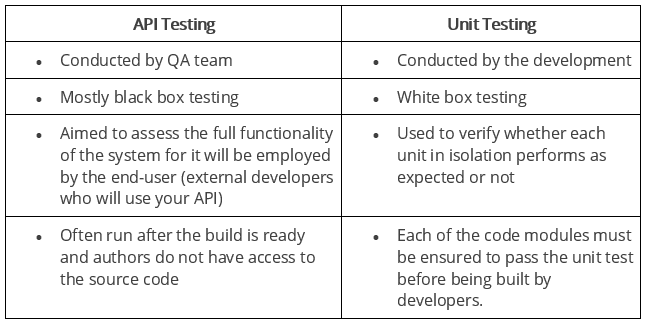
xvi. What are differences between API Testing and Unit of measurement Testing?
17. What are differences between API Testing and UI Testing?
18. What are major challenges faced in API testing?
xix. What are the testing methods that come under API testing?
20. Why is API testing considered as the almost suitable form for Automation testing?
21. What are mutual API errors that ofttimes founded?
22. What kinds of bugs that API testing would often find?
Documenting the API (Common Web API Testing interview questions)
23. What is API documentation?
24. What are API documentation templates that are commonly used?
25. When writing API document, what must exist considered?
26. How oft are the APIs changed and, more chiefly, deprecated?
REST (Common Spider web API Testing interview questions)
27. What is Balance?
In Residuum architecture, a Residuum Server provides access to resources and REST client accesses and makes these resource available. Here, each resource is identified by URIs or global IDs, and REST uses multiple ways to represent a resource, such as text, JSON, and XML. XML and JSON are nowadays the most pop representations of resource. 28. What is a RESTFul Web Services?
29. What is a "Resource" in Balance?
Residual Server gives access to resources and modifies them, where each resource is identified by URIs/ global IDs. thirty. What is the most popular way to correspond a resource in Balance?
XML and JSON are the virtually popular representations of resources. 31. Which protocol is used by RESTful Web services?
32. What are some key characteristics of Residue?
With a well-practical Balance API, the server could exist restarted between two calls, since all data is transferred to the server 33. What is messaging in RESTful Spider web services?
34. What are the core components of an HTTP request?
35. What are the most commonly used HTTP methods supported by REST?
36. Tin GET request to be used instead of PUT to create a resources?
37. Is there any difference between PUT and Post operations?
GET /device-management/devices : Get all devices
Mail service /device-management/devices : Create a new device
GET /device-management/devices/{id} : Get the device information identified by "id"
PUT /device-direction/devices/{id} : Update the device information identified by "id"
DELETE /device-management/devices/{id} : Delete device by "id" 38. Which purpose does the OPTIONS method serve for the RESTful Web services?
39. What is URI? What is the primary purpose of Rest-based web services and what is its format?
xl. What is payload in RESTFul Web services?
41. What is the upper limit for a payload to pass in the POST method?
42. What is the caching mechanism?
SOAP (Common Web API Testing interview questions)
43. What are SOAP Web services?
44. How does SOAP work?
45. When to use Lather API?
46. How users utilize the facilities provided by Lather?
47. What is the major obstacle users faced when using Lather?
48. What are the various approaches bachelor for developing Lather based web services?
49. What are the elements of a Lather message construction?
50. What are the syntax rules for a Lather message?
51. What is the transport method in SOAP?
The Soap requests tin be sent using an HTTP Get method while the specification only contains details about HTTP Post. 52. What are some of import characteristics of a SOAP envelope element?
53. What are the major functionalities provided by the Soap protocol class?
54. What are the web relation functionalities provided by SOAP protocol?
55. How does the message security model allow the creation of SOAP more secure to use?
56. What is the difference betwixt tiptop down & lesser up approach in Lather Web services?
57. What are advantages of Soap?
58. What are disadvantages of Soap?
59. What are the differences between Lather and Residue?

sixty. SOAP or Rest APIs, which method to use?
61. What are the factors that help to determine which style of Spider web services – SOAP or REST – to employ?
Prepare to succeed in your next Web API Testing interview
Trigger modal 
Source: https://katalon.com/resources-center/blog/web-api-testing-interview-questions
0 Response to "Take It to the Net Review Questions and Answers"
Postar um comentário