Who Helped Maya to Start Talking Again Caged Bird Review
Maya Angelou is one of the well-nigh important literary figures in twentieth century American history. Her poetry is oftentimes included on reading lists for high school English courses, and it may fifty-fifty make an appearance on the AP Literature exam. In this commodity, we'll give y'all a full introduction to Angelou and her engaging poetry and then that you'll be equipped to analyze it all on your ain. To practise this, we're going to guide you lot through a close analysis of one of Angelou's most famous poems, "Still I Rise." To assist you larn what Angelou's "Still I Rise" poem is all about, we'll cover the following in this article: Are you lot ready to swoop in? Then let's go! Maya Angelou, speaking at Wake Forest University, in 2008. (Kingofthedead/Wikimedia) In order to fully understand the meaning of a poem, information technology'south important to starting time past looking at the life of the poet who wrote information technology. Why? Because poets sometimes reference their ain life experiences, relationships, and personal identities in their works. In this instance, nosotros're going to look at the life of Maya Angelou, the poet who wrote the verse form, "Still I Ascent." Maya Angelou, whose given proper noun was Marguerite Annie Johnson, was born in St. Louis, Missouri, on April four, 1928. Her father, Bailey Johnson, was a doorman and navy dietician, and her mother, Vivian Johnson, was a nurse and card dealer. Growing upwardly, Angelou's home life was chaotic and sometimes emotionally distressing. Angelou's parents divorced when she was iii, and her home life became unstable. In the years following, Angelou and her brother were shuffled from place to place, including their grandmother'south domicile in Stamps, Arkansas. Subsequently returning to St. Louis at age eight, Angelou was sexually assaulted by her mother'southward young man, Freeman. Angelou told her blood brother, who told the rest of the family, and Freeman was arrested and charged. He was merely held in jail for one twenty-four hours, but he was murdered shortly subsequently his release. Some scholars think Angelou's uncles were responsible, seeking revenge for what Freeman had done to Angelou. After Freeman'southward murder, Angelou returned to live with her grandmother in Arkansas and spent v years nearly mute. It wasn't until a teacher and family friend, Mrs. Bertha Flowers, took an interest in Angelou that she was able to find her voice over again. Flowers introduced Angelou to authors such every bit William Shakespeare and Edgar Allen Poe, as well as Black female artists such as Frances Harper and Jessie Fauset. Years later, Angelou stated that she could no longer speak because she believed that her voice had killed Freeman. She felt that Freeman'south murder was proof that her words had the power to kill. However, it was during this difficult flow of her life that Angelou's involvement in poetry and writing began to take root. During this time, she also graduated loftier school and had her son, Clyde, at the historic period of seventeen. Angelou married her first husband, Enistasious Tosh Angelou, in 1951. Around this time, she began pursuing fine art more seriously. After her union ended in 1954, Angelou began dancing professionally at clubs in San Francisco. Her managers at the Purple Onion, a dark social club, suggested she formally adopt the proper noun, "Maya Angelou," which she did. In 1959, Angelou moved to New York City to concentrate on her writing career. She joined the Harlem Writers Guild, where she met several other African American authors and began publishing her work. In 1960, she met civil rights leader Martin Luther King, Jr. Later on hearing him speak, Angelou began volunteering to benefit the Southern Christian Leadership Conference (SCLC) and taking a stand every bit a political activist. Angelou's professional writing career took off when she and her son moved abroad in 1962. She worked as an editor at a newspaper in Cairo, Egypt, and wrote for various publications in Ghana as well. Angelou besides met and began working with human rights activist Malcolm X during her years in Africa. When she returned to the U.s.a. in 1964, Angelou helped Malcolm 10 ready the System of Afro-American Unity. The arrangement disbanded when Malcolm Ten was assassinated the next year. Angelou pursued writing more intensely in the years after traveling broadly, witnessing the demand for human and ceremonious rights, and processing the assassination of her fellow activists and friends, Martin Luther King, Jr. and Malcolm X. Throughout the 1970s, Angelou experienced her about productive writing period, writing manufactures, short stories, TV scripts, documentaries, autobiographies, and verse. Arguably, Angelou'south most famous work is her autobiography, I Know Why the Caged Bird Sings , published in 1969. But Angelou'south verse is too highly acclaimed. Both her autobiography and her poetry explore the complexities of her childhood growing upwardly in Missouri and Arkansas, racial discrimination, sexual assault, and womanhood. These works likewise emphasize the power of storytelling and the spoken word—two themes that find root in her childhood experiences too. Up until her decease on May 28, 2014, Angelou continued to write, teach, give lectures and poetry readings, and participate in political campaigning. She even directed a feature film! Angelou was a prolific creative person whose piece of work evokes powerful images of what being a Black child, woman, and artist was like in twentieth century America. Want to hear Maya Angelou recite "Yet I Rise" herself? Merely click on the video above! "Still I Rise" was originally published in the 1978 poesy collection, And However I Rise past Maya Angelou. "Still I Rise" is the volume'due south title poem and plays a crucial part in developing the collection'southward fundamental themes. It is likewise one of the about famous and widely read poems from this collection by Maya Angelou. Before nosotros can dig into what the significant of "However I Rise" is, we need to actually read the poem. Take a look at the full text of "Still I Rise" below. You may write me down in history Does my sassiness upset yous? Only like moons and like suns, Did you want to meet me broken? Does my haughtiness offend you? You may shoot me with your words, Does my sexiness upset y'all? Out of the huts of history'southward shame Leaving behind nights of terror and fear "Even so I Rise" was written to accost the discrimination that Black people confront due to systemic racism in the United States. One way that we can discern the meaning and themes of a poem is by looking at its background, including experiences in the poet's life and broader historical events that may have influenced the poet. Even so I Rise" was written to portray the resilience of Black people in response to racial discrimination and injustice. "Still I Rise" was written during the 1970s, when Angelou became involved in the civil and homo rights movements, engaged in political activism, and traveled away to Africa. These experiences likely gave Angelou an intimate look at many forms of discrimination around the globe. Angelou also met and worked with some of the about inspiring leaders of the civil and human rights movement during the 1960s and 1970s. This means that, while Angelou witnessed injustice, she as well got to meet the resilient spirit of Black people united in activity. These experiences with racism and resistance influenced Angelou'south writing during the 1970s and shaped the themes in many of her poems, including "Yet I Rise." On top of these influences, Angelou also had a traumatizing childhood, which included her ain personal experience with racial discrimination and sexual corruption. For Maya Angelou, "Still I Rise" and other poems are an outlet for processing that personal pain and finding ways to rise above the wounds individual people and society inflicted upon her. Now it's fourth dimension to practise a little investigation and figure out what Maya Angelou's poem is actually about! Now, let's dig into the meaning of "Still I Ascension" by Maya Angelou. Go ahead and reread the poem ane more than time so that information technology'south fresh in your mind as we talk about the "Still I Rise" poem's significant and themes. The central meaning of "Still I Ascension" tin be summed upwardly similar this: despite America's violent and discriminatory treatment of Blackness people, Blackness resilience is an unstoppable forcefulness and a beacon of promise. The poem's title, "Still I Rise," suggests that the verse form's speaker is ascension up despite or in response to challenging circumstances. As the verse form develops, we larn that the speaker rises upward in response to American social club'southward hatred and oppression of Black people. The speaker of the poem is Black, which nosotros learn in these ii lines in the last stanza: Bringing the gifts that my ancestors gave, The speaker's reference of slavery and ancestors situates them in a very specific cultural and racial part equally a Blackness person. Additionally, we encounter how this Blackness rises up in opposition of hate, bigotry, and oppression throughout the verse form. For example, in the 2nd stanza, the poem'southward speaker asks the reader: Does my sassiness upset you? The fourth and fifth stanzas pose questions to the reader in a like way, asking: Did you desire to see me broken? Does my haughtiness offend you? Angelou opens each of these stanzas with questions as she calls out everyone who has participated in the oppression of Black people. She demands an caption for their hatred, and each question calls out a specific instance of or type of mistreatment. Speaking on behalf of Black people who take experienced discrimination, the speaker questions why Blackness people are treated with violence and contempt. Equally the poem goes on, information technology becomes clear that those who detest Blackness people practice so because of the strength, beauty, and resilience of Blackness people...even though the Black community remains oppressed. We encounter this in the similes that compare the spirit of Blackness people to resources that are an endless wellspring of riches, similar "oil wells / Pumping in [the speaker's] living room" and "gold mines / Diggin' in [her] ain backyard." Using these comparisons, Angelou asks the reader to consider why it's the enduring hope, joy, and strength of Blackness people that makes others want to break them downwardly. While the strength and beauty of Black people incites hatred and intolerance, Angelou too portrays these qualities equally the ultimate source of Blackness people's force to keep rising back up. The speaker argues that Blackness people turn down to surrender in the face of society's racism and oppression. Instead, they respond with remarkable force. Now, let'southward take a closer look at the 3 major themes that ascertain Angelou'south poem: the relationship betwixt personal and commonage experience, the irrationality of racial hatred, and the enduring nature of Blackness resilience. Angelou not only talks well-nigh the means in which Black people collectively experience racism, she is asking readers to examine their role in perpetuating racism, too. The first theme we'll talk over that's important to understanding Maya Angelou's "Still I Ascension" is the relationship between personal and collective experience. Showtime, there are ii major characters in "Yet I Ascent": the Black speaker of the poem, and the person to whom they're asking their questions (the "you lot"/addressee). Permit's expect at the poem's addressee. Throughout "Still I Ascension," the poem's speaker addresses an unknown "you." At first glance, information technology may seem like this "you" could be anyone, but as we get deeper into the poem, it becomes clear that Angelou is addressing a specific blazon of person: anyone who despises or hurts Blackness people because of their racial identity. So, though it sounds like the speaker is addressing an individual when she says "you," she's actually referring to a group of like-minded people: all those individuals who participate in racial discrimination. When you read "y'all" in the verse form, that's who should come to mind. In that manner, Angelou targets a collective experience of racism and racist behavior as the main topic of her poem. But we can also break down the identity of the poem's "yous" a fleck more. We could also read Angelou'due south use of "you lot" equally her way of request all readers to wait inside themselves to encounter if they're complicit in racism, too. In other words, Angelou could be asking u.s. to examine ourselves for hidden biases: do nosotros experience whatsoever of the negative feelings toward Blackness people that the "you" portrayed in the poem experiences? And if we do, practice we want to be included in that mean "you lot?" By addressing the reader equally potentially being a role of that "y'all," Angelou gives us an opportunity to reflect on their internalized biases and decline harmful ones that nosotros may not have realized nosotros were harboring. In that mode, Angelou draws a strong connection between commonage actions and our individual responsibility. It's piece of cake to write off a group of people every bit "racist," but we accept to call back that group is made up of individual people. And more chiefly, "Yet I Rise" argues that it's our responsibility to make sure our own private ideas, beliefs, and actions aren't feeding a system that harms others. The poem'due south speaker also exhibits the relationship betwixt our individual selves and collective experiences. Throughout the poem, the speaker refers to themselves in the starting time person, frequently using "I" and "my" to refer to their experiences with racial bigotry. Merely in the first and last stanzas of the poem, Angelou's speaker indicates that their experiences are common and shared amid Black people. The speaker does this by referring to the function of history in documenting both the oppression of Black people and their response to this oppression. Throughout the poem, the speaker's individual experiences tie into the collective experiences of Black people. As the speaker "rises" from each individual attempt to break her or push her down, so practise Blackness people as a whole. This is on brandish in the following stanza: Leaving backside nights of terror and fear In this last stanza of the poem, the speaker reveals that their resilience, and that of their people, comes from a shared and enduring collective experience. When the speaker refers to "the gifts that my ancestors gave," they're talking well-nigh how the force of past Black people continues to undergird the Blackness community in the present. This is the historical narrative that truly defines who she is—non the bitter, twisted lies of their oppressors. And then in this example, the speaker's private decision to rise in the face of discrimination contributes to Blackness people'due south collective feel in the face of racism. And more importantly, her individual actions will help hereafter generations continue to ascent up and higher up equally well. Another important theme that Angelou portrays in "Notwithstanding I Rise" is the irrationality of racism. Angelou conveys this theme through rhetorical questions that demonstrate that the reasons people cite for antisocial Black people are lilliputian. The "y'all" who is addressed by the poem's speaker is portrayed equally being upset and offended because the speaker is sassy, hopeful, haughty, and sexy. Those seem like weird things to hate someone for, right? And you certainly wouldn't oppress someone just because they exhibit those qualities! That's exactly Angelou'due south betoken in this poem. She's showing that hatred and fear of Blackness people is irrational. The "biting, twisted lies" that came to define America's understanding of Blackness people since the early days of the country's existence didn't make sense then, and "Still I Rising" argues that they don't make sense at present. The poem reiterates that the lies that pigment Black people as unsafe or "less than" others are baseless and untrue. Instead, the speaker rewrites the story of who they are in order to rise up against the hateful "you" that they're addressing in the poem. By revealing the truth of who she is—sassy, sexy, human—she challenges the historical lies that support racist ideas. By asking the "you" if they are offended and upset because of who she truly is, Angelou's speaker exposes the irrationality of the hatred directed toward Blackness people. A last central theme that characterizes "Withal I Ascension" is the enduring nature of Black resilience. Throughout the poem, the speaker portrays the nature of their resilience through comparisons to things that are known for their toughness or ability to endure. Ultimately, these comparisons betwixt the resilience of the speaker and durable things symbolizes the resilient spirit of Blackness people in full general. Angelou's speaker characterizes their resilience as being similar to things from the natural globe that suffer through the weathering downwardly that occurs equally time passes. For instance, Angelou tells the poem'south "you" that, while they may be trodden into "the very dirt," like "dust" they'll rise again. And just similar the moon, lord's day, and the tides of the ocean—all of which autumn and ascension—the speaker volition go along to rising as well. Angelou makes these comparisons to portray the speaker'due south resilience in a specific way. Like the "certainty" of the patterns of the sun and moon, the speaker's resilience is sure. It won't fade away or diminish; it will endure. The speaker is ensuring the poem's "y'all" that no matter what hateful things they say or exercise, the speaker will rise up no thing what. The references to human being activities like pumping oil and mining golden work also the importance and value of resilience. The speaker says they walk similar they've got oil wells pumping in her living room, and laughs like they've got gold mines in their backyard. Of grade, the poem's speaker doesn't actually have oil wells and gold mines. Instead, the speaker makes these comparisons to testify their resilient spirit is more valuable than oil and more than precious than gold. Ultimately, the poem'southward speaker is recognizing that the poem's "y'all" can't comprehend the value of the speaker'south resilience, nor can they diminish the driving strength behind the speaker'south resilient spirit. Poetic devices are literary devices that poets utilize to enhance and create a poem's construction, tone, rhythm, and meaning. In Maya Angelou'due south poem, "Still I Rise," Angelou uses repetition and rhetorical questions to reinforce her poem'southward meaning. Repetition is often used in poetry to solidify a key idea or theme. Like to the refrain of a song, repetition tin can also be used to create a particular rhythmic effect and set a poem's mood. In "Still I Rising," Angelou'due south speaker repeats the refrain, "Yet I rise" and, "I ascent" to convey the ability of Black resilience and gear up a triumphant tone . The repetition of "Withal I rise" and "I ascent" ready up a stark contrast betwixt the hateful actions of the poem's "you" and the resilient response of the poem's speaker. Angelou describes how the poem's "yous" attempts to keep the speaker downwardly. The "yous" addressed by the speaker may "trod [them] in the very dirt," "shoot [them] with your words," and "cut [them] with your optics." These actions are all designed to pause the spirit of the speaker. But in response to each of these attempts to oppress them, the speaker repeats the phrase, "I rise." So whereas the hatred portrayed in the poem is dingy and low, the speaker'south resistance rises high to a higher place these kinds of exchanges. Rather than responding with hatred, the speaker walks, laughs, and dances, rejecting the lies of those who would oppress them. The repetition of the phrase, "I rise" is as well symbolic: it conveys the ongoing resilience of the spirit of Black people in response to ongoing racism and discrimination. With each repetition of "I rise," the reader gets a sense of just how stiff and resilient the speaker is. This repetition emphasizes the speaker's bulletin that attempts to keep Blackness people down will never be successful. As the verse form'south eighth stanza says, the resilience of Blackness people is like the sea: Up from a past that's rooted in pain In other words, "rising upwards" is not something that the speaker and, by extension, Black people, do simply one time. Because racial oppression also endures, Blackness people find themselves ascent upward over again and once again. Rhetorical questions are the other master poetic device that Angelou uses to convey the "Still I Rise" meaning. Rhetorical questions are questions that a writer poses in order to brand the reader come upwards with their own reply--and think more deeply about complicated issues in the processes. Writers oftentimes use rhetorical questions to guide readers toward answers that reinforce the verse form's bulletin. In "Nonetheless I Ascent," rhetorical questions announced at the beginning of 4 of the stanzas. Each rhetorical question in this poem is addressed to the verse form's "y'all." Each question asks about the ways in which the speaker offends the addressee. This technique allows Angelou to investigate why the addressee hates the speaker...which also allows her to shine a light on the flimsy reasons behind racism as well. The repetition of these rhetorical questions sets a tone that feels more similar an interrogation than a conversation—and this is intentional. Each rhetorical question directed toward the mean "you" in the poem serves to condemn their hatefulness, especially when Angelou's speaker begins answering the questions herself. Additionally, the speaker answers the rhetorical questions for the reader in social club to help readers meet the insubstantial motivations behind their hatred of Blackness people. Have the question and answer sequence in the poem's fifth stanza for example: Does my haughtiness offend you? The stanza above begins with a rhetorical question directed at the reader about haughtiness. Simply Angelou's speaker also answers the question themselves, revealing that they already know the "you" in the poem is offended by her haughtiness. Ultimately, Angelou uses rhetorical questions to ask the collective "you" addressed in the poem to reflect on their own hatefulness and intolerance. Past answering these questions with declarative statements throughout the poem, Angelou is signaling to the poem's "you" that Black people aren't confused about where this hatred comes from. They empathise that Black people's refusal to surrender in the confront of ongoing lies and cutting downs merely makes those who are filled with hate even angrier. In fact, these rhetorical questions, piled up 1 subsequently the other in the verse form, convey an attitude of defiance. They prompt the poem's "you" to substantially ask themselves, "Did you really retrieve your hatred could keep united states of america down?" Nevertheless, by stating the violence confronting Blackness people with each rhetorical question and communicating a resilient response to each cutting down in her answers, Angelou emphasizes just how potent Black people are. Analyzing poetry can be catchy, and then it'southward helpful to read a few skilful analyses. We have a bunch on our web log that you tin read through, like this 1 about Dylan Thomas' "Practice not go gentle into that proficient night" or this article that explains x different sonnets! Information technology's much easier to clarify poetry when you have the right tools to do it! Don't miss our in-depth guides to poetic devices like assonance, iambic pentameter, and allusion. If you're more nigh writing poesy than analyzing it, we've got yous covered! Here are five dandy tips for writing poetry (and a few scholarships for budding poets, too). Need more help with this topic? Check out Tutorbase! Our vetted tutor database includes a range of experienced educators who can assist you smoothen an essay for English or explicate how derivatives work for Calculus. You can utilise dozens of filters and search criteria to find the perfect person for your needs. 
Meet the Poet, Maya Angelou
Maya Angelou's "Still I Rise" Poem
"Even so I Ascent" past Maya Angelou
With your bitter, twisted lies,
You may trod me in the very dirt
Just yet, like dust, I'll rise.
Why are y'all aggress with gloom?
'Crusade I walk like I've got oil wells
Pumping in my living room.
With the certainty of tides,
Just similar hopes springing high,
Still I'll rise.
Bowed head and lowered optics?
Shoulders falling downward like teardrops,
Weakened by my soulful cries?
Don't you have it awful hard
'Cause I laugh like I've got gold mines
Diggin' in my ain lawn.
You may cutting me with your eyes,
You may kill me with your hatefulness,
But yet, like air, I'll rise.
Does it come equally a surprise
That I dance like I've got diamonds
At the meeting of my thighs?
I ascension
Up from a by that'south rooted in pain
I rise
I'm a black ocean, leaping and wide,
Welling and swelling I conduct in the tide.
I rise
Into a daybreak that's wondrously clear
I rise
Bringing the gifts that my ancestors gave,
I am the dream and the hope of the slave.
I rise
I ascension
I rising.
The Background Behind the "Yet I Rising" Verse form

"Still I Ascension": Meaning and Themes
"Still I Rise" Poem Meaning
I am the dream and the hope of the slave.
Why are you beset with gloom?
'Cause I walk like I've got oil wells
Pumping in my living room.
Bowed head and lowered eyes?
Shoulders falling downwardly like teardrops,
Weakened by my soulful cries?
Don't y'all take it awful hard
'Cause I laugh similar I've got golden mines
Diggin' in my own backyard.
Theme 1: The Relationship Between Personal and Collective Experience
I rise
Into a daybreak that'south wondrously clear
I rise
Bringing the gifts that my ancestors gave,
I am the dream and the promise of the slave.
I rise
I rise
I rise. Theme 2: The Irrationality of Racism

Theme 3: The Enduring Nature of Black Resilience

The Meridian 2 Poetic Devices in "Still I Ascent"
Poetic Device ane: Repetition
I ascent
I'm a black ocean, leaping and wide,
Welling and swelling I conduct in the tide. Poetic Device 2: Rhetorical Questions
Don't you lot take it awful difficult
'Cause I express mirth like I've got gilded mines
Diggin' in my own lawn.
What's Next?

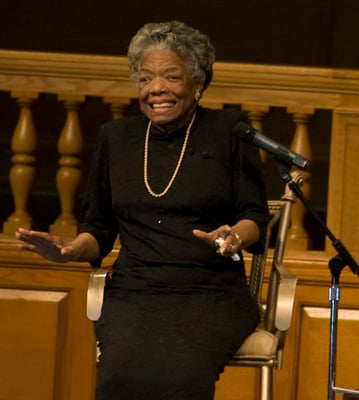

Ashley Sufflé Robinson has a Ph.D. in 19th Century English Literature. As a content writer for PrepScholar, Ashley is passionate nearly giving higher-bound students the in-depth information they demand to go into the school of their dreams.
Source: https://blog.prepscholar.com/maya-angelou-still-i-rise-poem
0 Response to "Who Helped Maya to Start Talking Again Caged Bird Review"
Postar um comentário